A power outage can shut down more than lights. For a business, it can stop point-of-sale systems, spoil inventory, disable security, interrupt production, and send employees home. The best standby generators for businesses are not simply the largest units available. They are professionally sized systems designed around the equipment, safety requirements, and operating priorities that keep your doors open.
A dependable commercial generator is a long-term continuity investment. The right system starts automatically, carries the loads that matter most, and is backed by installation and service support that does not disappear after commissioning.
What Makes the Best Standby Generators for Businesses?
There is no single generator model that is best for every business. A small office that needs internet, lighting, HVAC, and computers during an outage has very different needs than a restaurant protecting refrigeration or a warehouse operating loading equipment and security systems.
The right choice comes down to four questions: What must stay powered? How much power do those loads require at startup and while running? How long must the business operate without utility power? And who will maintain the system after it is installed?
A professionally designed standby system includes more than the generator itself. It includes an automatic transfer switch, properly sized electrical infrastructure, fuel planning, site preparation, permits, testing, and a maintenance plan. Skipping any one of these steps can leave a business with expensive equipment that does not perform when an outage occurs.
Automatic operation is non-negotiable
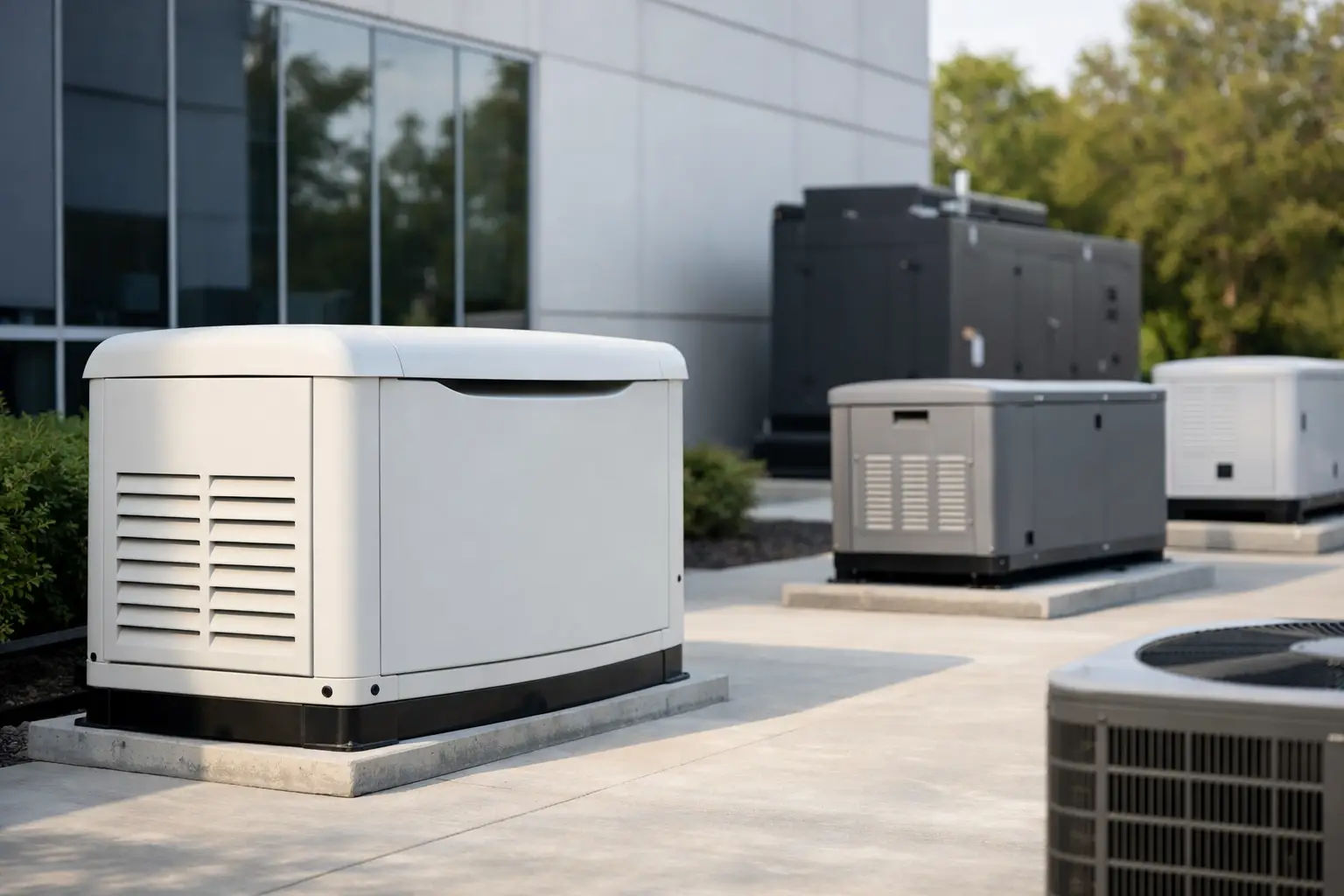
A true standby generator monitors incoming utility power. When it senses an outage, it starts automatically and the transfer switch moves selected electrical loads to generator power. When utility power returns and stabilizes, the system safely transfers the building back.
That automation matters when outages happen overnight, during severe weather, or when no one is available to start portable equipment. It also protects staff from the risks of manually connecting power during a stressful event.
Sizing must account for startup demand
Many business owners look at the wattage printed on equipment labels and add the numbers together. That is a starting point, but it is not a generator design. Motors in HVAC systems, refrigeration compressors, pumps, and certain machinery can require significantly more power when starting than when running.
An undersized generator may start but struggle when a major load cycles on. It can overload, shut down, or force your team to choose which essential systems stay online. A qualified installer performs a load assessment, identifies motor starting requirements, and determines whether load management or staged startup is appropriate.
Generator Types That Fit Common Commercial Needs
Commercial standby generators are commonly grouped by fuel source and engine design. Each option has a place, and the best fit depends on the site, available utilities, runtime expectations, and critical loads.
Natural gas standby generators
Natural gas is often a practical choice for offices, retail locations, medical practices, and many light commercial facilities with reliable gas service. Because fuel is supplied through a utility line, there is no need to refuel a tank during a shorter outage. The system can run as long as gas service remains available and the generator is properly maintained.
The trade-off is fuel capacity and pressure. Gas service must be evaluated to confirm it can support the generator while other building appliances are operating. During widespread disasters, local utility conditions can also affect availability. A professional fuel assessment is part of responsible system design, not an optional add-on.
Propane standby generators
Propane gives businesses more control over onsite fuel storage. It is a strong option where natural gas is unavailable or where owners want an independent fuel supply. Propane stores well and can support dependable operation when the tank is correctly sized for the generator and anticipated runtime.
The limitation is straightforward: the system will only run as long as fuel remains in the tank. A business that needs extended outage protection must plan tank capacity, refueling access, and seasonal fuel use carefully. Cold weather and heavy loads can affect consumption, so estimates should be based on real operating conditions rather than best-case assumptions.
Diesel commercial generators
Diesel generators are frequently selected for larger commercial loads, long runtime expectations, and applications where high power output is required. They are common in industrial settings, larger facilities, and operations with significant motor loads.
Diesel systems can deliver substantial capacity, but they also require disciplined fuel management, periodic fuel-quality checks, and more involved maintenance. For the right facility, that added responsibility is worth it. For a smaller business with modest critical loads, a natural gas or propane system may be simpler to own and support.
Air-cooled versus liquid-cooled systems
Air-cooled generators are often suitable for smaller commercial applications with limited essential loads. They can be cost-effective and compact, but they have practical limits on output and extended-duty performance.
Liquid-cooled generators are generally better suited to larger load demands and longer operating periods. They offer a broader range of capacities and are built for more demanding use. The higher upfront investment may be justified when downtime creates serious financial, operational, or safety consequences.
Match the Generator to the Loads That Protect Revenue
The most effective commercial backup plan distinguishes between critical loads and convenient loads. During an outage, a business may not need every light, outlet, and piece of equipment operating at once. It does need the systems that protect people, revenue, inventory, and the ability to reopen quickly.
For a restaurant, critical loads may include walk-in coolers, freezers, refrigeration controls, limited kitchen equipment, lighting, internet, and point-of-sale systems. A medical or dental office may prioritize refrigeration for temperature-sensitive materials, selected treatment equipment, IT systems, and security. For offices, internet, communications, emergency lighting, servers, and a limited number of HVAC zones may be the practical target.
This approach often reduces generator size without reducing protection. It also prevents a common mistake: buying capacity for every possible load, then overlooking the transfer switch configuration, electrical panel capacity, or fuel supply needed to make the system work.
Installation Quality Determines Whether the System Works When Needed
A generator is only as dependable as the installation behind it. Commercial standby power involves electrical code requirements, fuel connections, site clearances, noise considerations, permits, and coordination with the serving utility where applicable. Poor workmanship can create nuisance shutdowns, unsafe conditions, warranty issues, and expensive corrections later.
A complete installation process should begin with an onsite consultation and load review. From there, the contractor should provide a clear scope covering generator capacity, transfer equipment, fuel work, placement, permitting, and expected project steps. After installation, the system should be tested under load so the owner understands what will happen during an actual outage.
Ask who handles service after startup. The answer matters as much as the equipment brand. Businesses should know who will respond when an alarm appears, whether parts and factory-trained technicians are available, and how routine maintenance will be scheduled.
Maintenance Is Part of the Purchase Decision
Standby generators spend most of their lives waiting. That is exactly why they require regular attention. Batteries weaken, fluids age, connections loosen, filters become dirty, and fuel can degrade. A generator that starts during a brief weekly exercise is not necessarily ready to carry a building during a multi-hour outage.
A commercial maintenance plan should include scheduled inspections, exercise verification, battery testing, fluid and filter service, transfer switch checks, and load testing at appropriate intervals. Diesel units also need fuel monitoring and treatment where necessary. Remote monitoring can add another layer of confidence by alerting the service team when the generator reports a fault or abnormal condition.
Do not treat maintenance as an optional cost after installation. It is the practical proof that your backup plan will be ready when utility power is not.
Choose a Partner, Not Just a Generator
The lowest installation quote can be tempting, especially when several contractors appear to offer similar equipment. But standby power is not a one-day purchase. It is an infrastructure system that must operate years from now, often in the worst weather and under the most pressure.
Look for a provider that can explain sizing in plain language, provide transparent scope details, manage permits and coordination, and remain available for service. At GenTek Power, the focus is on taking responsibility for the complete standby power process, from consultation and installation through testing, maintenance, and support.
The best time to find out whether a generator is properly sized and professionally installed is before the next outage puts your business to the test.