When people ask for a whole home backup power example, they usually are not asking for theory. They want to know what this looks like in a real house, what stays on during an outage, how big the generator needs to be, and whether the result is worth the investment.
A practical example makes the decision easier because backup power is not just about watts on paper. It is about whether your heat runs on a freezing night, whether your sump pump keeps the basement dry, whether your fridge and freezer stay cold, and whether your home office or medical equipment stays online when the grid does not.
A whole home backup power example
Consider a 3,000-square-foot single-family home with natural gas service, central air conditioning, a finished basement, a sump pump, two refrigerators, a well-planned home office, and a family that wants the house to function normally during an outage. They do not want to choose between the air conditioner and the microwave. They do not want extension cords. They want an automatic standby system that detects the outage, starts within seconds, and powers the house through a properly installed transfer switch.
In this example, the homeowner’s priority loads include the furnace blower, central AC, both refrigerators, freezer, sump pump, lighting circuits, internet equipment, garage door opener, kitchen outlets, microwave, dishwasher, washing machine, gas water heater controls, and several bedroom and bathroom circuits. They also want enough capacity for normal day-to-day use instead of a stripped-down emergency mode.
That usually points toward a whole-home standby generator rather than a small portable unit or a partial-load solution. Depending on the actual electrical demand and startup loads, a home like this often lands in the 20 kW to 26 kW range. In some homes, 18 kW can work. In others, larger HVAC equipment, electric appliances, or a pool system push the requirement higher.
What the system might include
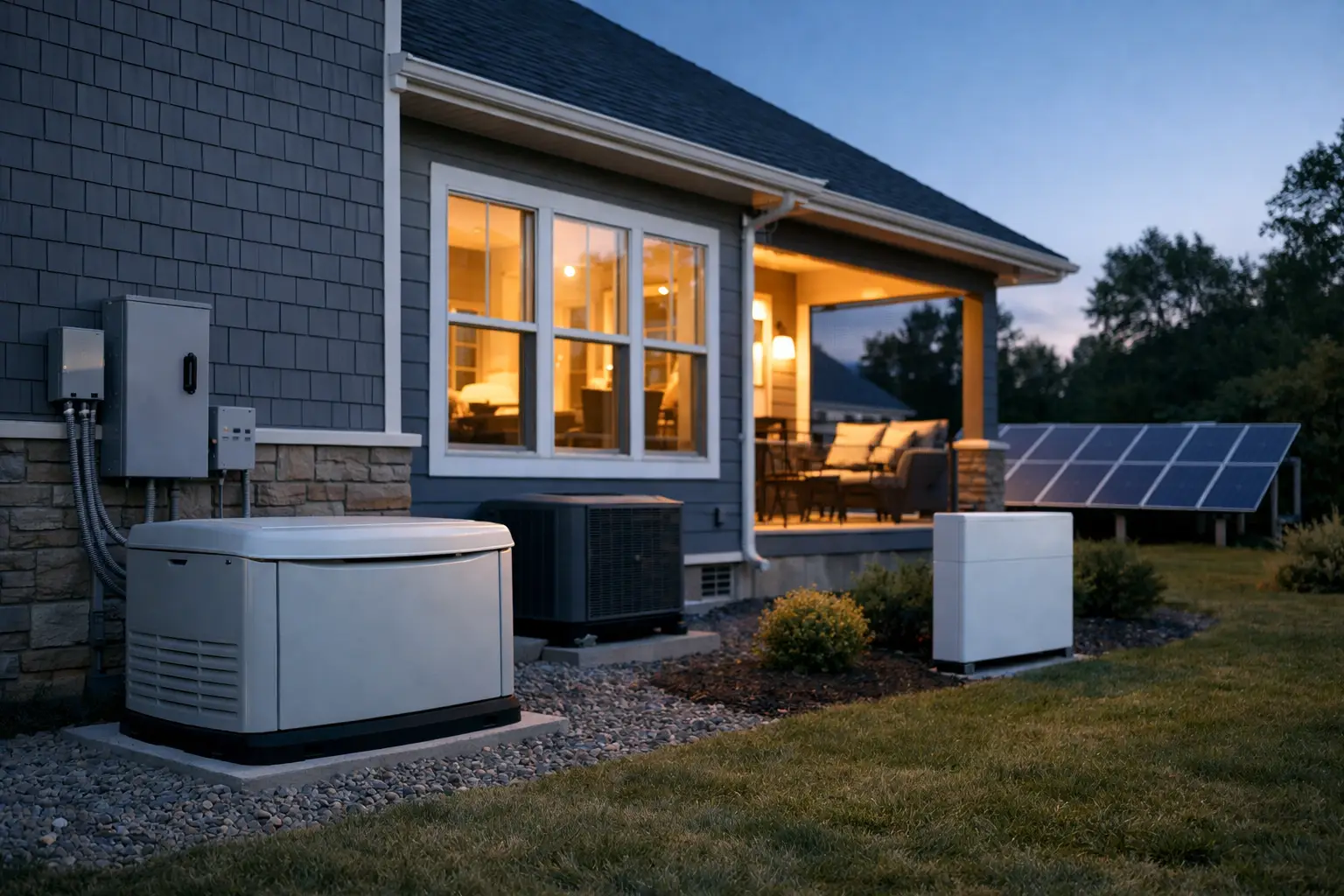
For this whole home backup power example, a typical system design would include a permanently installed standby generator on a concrete or composite pad, an automatic transfer switch, gas piping sized for the generator’s fuel demand, electrical integration with the home’s main service, startup testing, and final commissioning.
If the home has natural gas, that is often the preferred fuel because it supports long-duration outages without refueling. If natural gas is not available, propane can be an excellent option, but tank sizing matters. A generator is only as dependable as the fuel supply behind it.
The transfer switch is one of the most important parts of the installation. It safely disconnects the home from utility power during an outage and transfers the electrical load to the generator. When utility power returns and stabilizes, it transfers the home back. That process needs to be installed correctly, permitted correctly, and tested correctly. This is not a place for shortcuts.
What happens during the outage
In a real outage, the sequence is simple from the homeowner’s point of view. Utility power fails. The generator senses the interruption, starts automatically, and after a short delay the transfer switch moves the house onto generator power. Most homeowners experience a brief interruption, then the house comes back to life without dragging cords through rain or finding fuel at the worst possible time.
That convenience matters, but reliability matters more. Automatic operation is what protects homes when the outage starts at 2 a.m., when the family is away, or when no one is available to manually connect equipment.
How sizing works in the real world
This is where many online examples go wrong. They make generator sizing look like simple addition. In reality, proper sizing depends on running wattage, startup amperage, motor loads, HVAC behavior, fuel type, service configuration, and the homeowner’s expectations.
For example, a central air conditioner may have a moderate running load but a much higher startup demand. A well pump or sump pump can create similar spikes. If the home has electric heat, electric water heating, or an electric range, the generator requirement changes significantly. The same goes for EV charging, workshops, or detached structures.
That is why a trustworthy contractor does not just guess based on square footage. They evaluate the actual electrical loads, review the panel, confirm fuel availability, and match the equipment to the home’s real operating conditions. If a company offers a price before understanding those details, that is a warning sign.
What this example might cost
For a professionally installed whole-home standby generator system, total investment can vary widely based on generator size, site conditions, permitting, fuel work, electrical complexity, and local code requirements. A straightforward residential project may fall into one price range, while trenching, service upgrades, difficult access, or larger equipment can move it upward.
The key point is not finding the cheapest number. It is understanding what is included. A lower quote may leave out critical items such as utility coordination, permit handling, gas upgrades, load management, startup testing, remote monitoring setup, or ongoing service support. That is where customers get surprised later.
A complete proposal should clearly explain the scope of work, equipment being installed, responsibilities for permits and inspections, and what happens after the installation is finished. Reliable backup power is not a one-day transaction. It is an infrastructure system that needs to perform years from now, during bad weather, under stress.
Why one home’s example may not match another
The most useful lesson from any whole home backup power example is that every home has its own version of whole-home power. Some families want basic continuity – refrigeration, heat, lights, internet, and sump pump protection. Others want the house to operate almost exactly as it does under normal utility power.
Neither approach is wrong. It depends on what the home supports and what the homeowner is protecting.
A family with young children, a home business, and a finished basement may place a high value on full comfort and flood prevention. A homeowner with medical equipment may prioritize uninterrupted power above everything else. Someone working remotely may care just as much about internet, office circuits, and HVAC as they do about kitchen convenience.
That is why good system design starts with the outcome, not just the equipment. The right question is not only, “How big of a generator do I need?” It is also, “What do I need my home to keep doing when the grid is down?”
The installation side most homeowners never see
The visible part of a generator project is the unit outside. The hidden part is what determines whether it works safely and reliably.
A proper installation includes code-compliant placement, correct clearances, correct gas pressure and pipe sizing, transfer switch integration, utility coordination where required, permit approvals, inspection signoff, and full operational testing. It also includes making sure the system exercises properly, the battery charger works, alarms are configured, and the homeowner understands what to expect during operation.
This is one reason homeowners who want dependable standby power often choose a company that manages the entire process. GenTek Power is built around that model because backup power only works as promised when design, installation, and long-term service are handled with the same level of care.
Service after the sale matters more than people think
A standby generator is not install-and-forget equipment. It needs routine maintenance, periodic testing, and service support from technicians who know the system. Batteries age. Filters need replacement. Firmware and monitoring settings may need attention. Fuel and load performance should be checked over time.
If a contractor disappears after installation, the risk shifts back to the homeowner. That is exactly what many customers are trying to avoid.
A stronger long-term plan includes scheduled maintenance, clear service records, and support when the generator throws a fault code or fails an exercise cycle. The system should be ready before the storm arrives, not diagnosed in the middle of one.
What to take from this example
If you are comparing options, the real takeaway from a whole home backup power example is this: the best system is the one that matches your house, your outage risk, and your expectations for normal life during a power failure. A generator that is too small creates frustration. A system installed without proper planning creates liability. A bargain price without service support can become expensive fast.
The right project feels different from the start. The scope is clear. The sizing makes sense. The installer explains trade-offs. Permits and coordination are handled. Testing is part of the process. Ongoing maintenance is not an afterthought.
When the lights go out, you should not be wondering whether the system was sized correctly or whether someone cut corners. You should be hearing the generator start and getting on with your evening.