A single power loss during business hours can do more than turn the lights off. It can stop point-of-sale systems, shut down network equipment, spoil inventory, interrupt tenant services, and put staff in a difficult position with customers. This commercial outage prevention case study shows what actually changes when a business stops treating backup power as an afterthought and starts planning for continuity before the next storm or grid failure.
The example is familiar because the problem is familiar. A mid-sized commercial property with multiple tenants had already lived through several utility outages in two years. None lasted long enough to make headlines. All lasted long enough to create real losses. Access control dropped offline, emergency callouts increased, refrigerated inventory in one tenant space was at risk, and property management was left scrambling for updates with no clear restoration timeline.
The owner did what many commercial owners do at first. They looked for the quickest way to get a generator installed. That sounds practical, but it is often where expensive mistakes begin. In outage prevention, speed matters less than getting the system right.
What the site was dealing with before backup power
This property was not a hospital or a data center. It was the kind of building many owners assume can tolerate downtime until they experience it in real terms. The outage exposure came from several directions at once. Shared lighting and common area power affected safety and tenant confidence. Internet and telecom interruptions disrupted payment processing and day-to-day operations. One tenant had refrigeration needs, another relied on continuous connectivity, and the property management team needed doors, alarms, and basic building systems to stay functional.
That mix is exactly why commercial standby planning is rarely as simple as matching generator size to total building square footage. Different loads matter in different ways. Some are essential for life safety and code compliance. Others are operationally critical because they prevent lost revenue, damaged product, or reputational harm. Good planning starts by separating what must run from what would merely be nice to have.
In this case, the owner’s first assumption was that they needed whole-building backup. After a proper assessment, that changed. The smarter and more cost-effective solution was selective coverage for critical systems and tenant continuity priorities, with room for future expansion.
The commercial outage prevention case study: what changed
The turning point was moving from a product mindset to a system mindset. Instead of asking, “Which generator should we buy?” the better question became, “What exactly needs to stay operational, under what conditions, and for how long?”
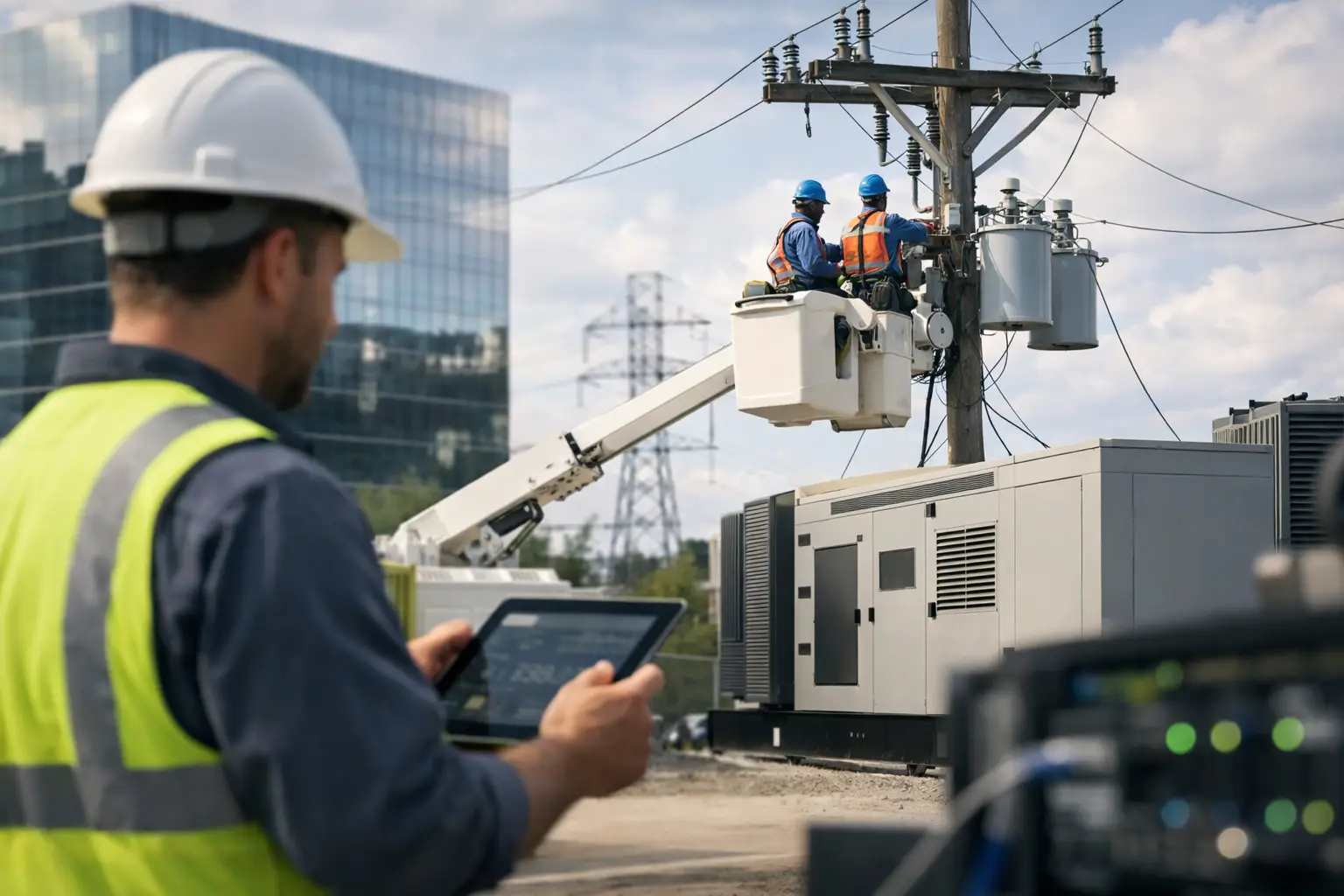
That led to a structured site review. Electrical loads were evaluated, startup demands were considered, transfer requirements were mapped, and the installation environment was checked for placement, ventilation, access, fuel considerations, and code constraints. Utility coordination and permitting were treated as core parts of the project, not paperwork to figure out later.
This is where many low-price proposals fall apart. They may quote a generator, but not a complete outage prevention plan. If the load calculation is rushed, the unit may be undersized and fail when multiple systems start at once. If the transfer setup is poorly designed, critical circuits may not behave as expected during an outage. If service access is ignored, routine maintenance becomes harder and emergency repairs take longer.
A professionally managed project avoids those risks by treating installation, testing, and long-term support as one continuous responsibility.
Step 1: Define critical loads, not just total loads
The first real improvement came from identifying the building’s true outage priorities. Common area lighting, security systems, access control, telecom equipment, networking hardware, refrigeration circuits for the affected tenant, and selected HVAC support were placed at the top of the list. Nonessential loads were intentionally excluded.
That decision mattered for two reasons. First, it kept the generator size aligned with real needs rather than worst-case assumptions. Second, it improved reliability. A right-sized system that is engineered for essential demand is often more dependable than an oversized solution built on guesswork.
Step 2: Plan for real startup conditions
Not all electrical loads behave the same way when power returns. Motors, compressors, and HVAC equipment can create startup surges that exceed their running load by a wide margin. If those surges are not accounted for, a generator that looks adequate on paper may struggle in the moments that matter most.
In this case, startup sequencing and transfer behavior were part of the design conversation from the beginning. That reduced the risk of nuisance shutdowns and helped ensure the system could handle actual outage conditions, not just ideal ones.
Step 3: Treat permitting and coordination as risk control
Commercial owners often underestimate how much project risk sits outside the generator itself. Permitting delays, utility coordination issues, site access limitations, and code requirements can all slow down a project or force costly changes late in the process.
When those details are handled early, the installation moves more predictably. When they are ignored, even a quality generator can become part of a frustrating project. This case worked because the planning covered the full scope, from equipment selection to approvals, placement, testing, and turnover.
Results that mattered to the owner
The obvious result was outage continuity. When the next utility interruption hit, the critical systems stayed online. But the more important result was operational control. Staff were not improvising. Tenants were not left in the dark, literally or figuratively. Building management could communicate clearly because the backup plan had already been tested.
That is the part owners tend to value most after installation. Backup power is not just about electricity. It is about reducing uncertainty when customers, tenants, employees, or residents are looking for answers.
There were also financial benefits, though they were not all visible on a single invoice. Reduced product loss, fewer emergency callouts, less tenant disruption, and lower exposure to reputational damage all contributed to the return on investment. For some businesses, one avoided outage can justify the decision. For others, the payoff comes from repeated small interruptions that no longer escalate into larger operational problems.
What this commercial outage prevention case study really proves
The lesson is not that every commercial property needs the biggest standby generator available. It is that outage prevention works best when it is engineered around the building, the business, and the consequences of downtime.
There is always a trade-off conversation. A whole-building system provides broader coverage but comes with higher equipment, installation, and fuel planning costs. A selective backup strategy lowers cost and complexity but requires careful decisions about what gets protected. Neither option is automatically right. It depends on what the site supports, what the business can tolerate, and how much risk the owner is carrying during every outage.
That is why experienced guidance matters. The real value is not just installing equipment. It is removing the guesswork that leads to undersized systems, overbuilt budgets, permit problems, and service gaps later on.
Why long-term service belongs in the original plan
A backup generator is not a set-it-and-forget-it asset. Commercial owners who focus only on installation often end up disappointed later when maintenance is inconsistent or emergency support is hard to reach. Prevention includes what happens after commissioning.
Routine maintenance, exercise cycles, battery checks, transfer switch inspection, load testing when appropriate, and clear service accountability all play a role in whether the system performs when the grid fails. A generator that has not been properly maintained can create a false sense of security, which is often worse than having no system at all.
That is one reason many business owners prefer working with a company that manages the full process and stays involved after the sale. GenTek Power was built around that model because standby protection only works when someone owns the job from planning through ongoing support.
What business owners should take from this example
If your facility has already experienced one painful outage, that is usually enough data to act on. You do not need to wait for a larger failure to confirm the risk. Start by asking what an hour without power actually interrupts. Then ask which of those interruptions are unacceptable.
From there, the right path becomes clearer. You may need selective backup for critical systems. You may need a larger standby solution. You may need to correct outdated assumptions about load, transfer, or fuel supply. What matters is building a plan that matches your operation instead of buying equipment based on rough estimates.
The businesses that handle outages best are rarely the ones that moved fastest. They are the ones that planned carefully, sized correctly, installed professionally, and kept service support in place long after the equipment was commissioned.
If there is a good time to solve backup power, it is before the next outage gives you the same lesson at a higher cost.