The quote looks straightforward until the real-world details show up. That is where generator installation hidden costs tend to catch homeowners and business owners off guard – not because standby power is a bad investment, but because the final price depends on the site, the fuel source, the electrical system, and whether the installer is pricing the full job or just the easy part.
A professionally installed standby generator should protect your property when the grid fails. It should start automatically, carry the right loads, meet code, and keep working year after year. When a low quote skips the less visible parts of the project, the cost does not disappear. It usually comes back later as a change order, a delay, or a reliability problem.
Why generator installation hidden costs happen
Most hidden costs are not tricks. They come from decisions that cannot be made accurately until someone evaluates the site in person. A generator is not a plug-in appliance. It is a permanently installed system that ties together electrical work, fuel supply, code compliance, placement rules, and startup testing.
That is why two properties with the same generator model can have very different installation costs. One home may have a clear path for gas piping and conduit. Another may need trenching, panel work, utility coordination, or a concrete pad because of grading and drainage. The equipment price may be similar, but the labor and supporting work can be very different.
The biggest generator installation hidden costs
Site preparation and placement
Where the generator sits has a direct impact on cost. The unit has to meet manufacturer clearance requirements, local code, and practical access for service. If the ideal spot is farther from the gas meter or electrical service, installation becomes more labor-intensive.
Site prep can include leveling the ground, improving drainage, pouring a pad, or moving obstacles like fencing, shrubs, or stored materials. On some properties, access is tight enough that extra labor or equipment is needed just to get the generator into place safely.
Electrical panel and transfer switch work
Many buyers focus on the generator itself and overlook the electrical side. The generator needs to connect through the correct transfer equipment, and that part of the job has to match your service setup and backup goals.
If your existing panel is outdated, overcrowded, or not configured for the planned transfer switch, upgrades may be needed. A whole-home solution may also require load management or service modifications to prevent overloading the system. None of that is optional if the goal is safe, code-compliant performance during an outage.
Gas line upgrades
This is one of the most common surprise costs. A standby generator needs adequate fuel volume, not just a nearby gas connection. If the existing natural gas or propane piping is undersized, the generator can starve for fuel under load, which leads to poor performance or shutdowns when you need power most.
The fix may involve larger piping, longer pipe runs, regulator changes, propane tank considerations, or coordination with the gas utility. This is not an area to cut corners. Fuel supply has to be designed for the generator’s actual demand, not guessed at.
Permits, inspections, and utility coordination
A legitimate generator installation usually involves permits and inspections. Depending on the jurisdiction and the scope of work, there may also be utility approvals or scheduling requirements that affect timeline and cost.
Low-price installers sometimes present permitting as an add-on, or worse, they leave customers to discover later that it was never included. That creates risk on several fronts. Unpermitted work can lead to failed inspections, resale issues, warranty problems, or safety concerns that are expensive to correct.
Trenching and restoration
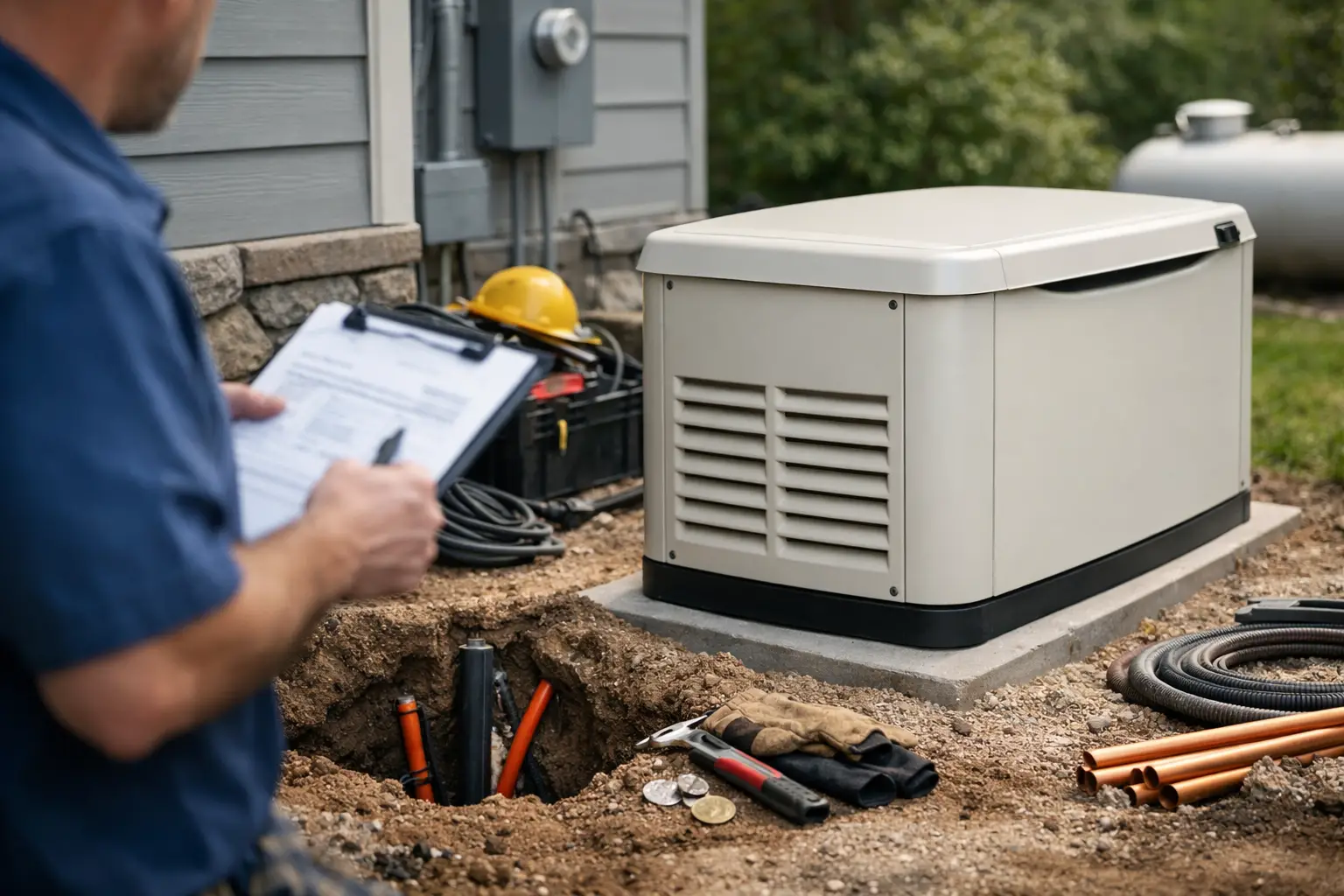
If electrical conduit or gas piping has to run underground, trenching can add a meaningful amount to the project. The actual digging is only part of the cost. Restoration matters too.
Concrete, pavers, landscaping, irrigation lines, and finished surfaces can all complicate the job. A short trench across open soil is one thing. Cutting and restoring a driveway edge or working around mature landscaping is another. Every site has its own trade-offs.
Costs that show up after the install
Not every expense hits before commissioning. Some of the most overlooked costs arrive after the generator is already in place.
Maintenance and periodic service
A standby generator is an engine-driven system, which means it needs routine maintenance to remain dependable. Oil changes, filter replacements, battery checks, software updates, inspections, and exercise verification all matter. Skipping service can shorten equipment life and increase the chance of a no-start condition during an outage.
This is one reason the cheapest installation is rarely the lowest long-term cost. If the installer disappears after startup, you may end up hunting for service later from a company that did not design or install the system.
Battery replacement and wear items
Batteries do not last forever, and neither do certain consumables and wear components. That is normal ownership, but it should be part of the budgeting conversation from the start. A standby generator is built for reliability, not zero maintenance.
Remote monitoring and emergency support
Some owners want basic backup power and are comfortable handling service reminders manually. Others want remote monitoring, priority emergency response, and a service relationship that continues long after installation. Those programs add value, but they do affect total ownership cost.
For many homes and businesses, that is money well spent. If you rely on refrigeration, medical devices, internet connectivity, sump pumps, or uninterrupted operations, fast support during an outage is not a luxury. It is part of the protection you are buying.
The low quote problem
A low number on paper can mean several different things. Sometimes it reflects a genuinely simple project. Other times it means key scopes were left vague, excluded, or deferred until the job is underway.
That is where customers get frustrated. They thought they were comparing complete installations, but they were actually comparing different assumptions. One quote may include permits, startup, gas upgrades, and final testing. Another may price only the generator, transfer switch, and a basic hookup under ideal conditions.
This is why professional site assessment matters. Reliable contractors do not promise an unrealistic price just to win the job. They identify likely complications early, explain what is included, and tell you where allowances or unknowns remain.
How to protect yourself from generator installation hidden costs
The best defense is not aggressive bargain-hunting. It is clarity. Ask whether the proposal includes site prep, the pad, permits, inspections, gas work, trenching, electrical upgrades, startup, and testing. Ask what assumptions were made about panel condition, fuel capacity, and installation distance.
It also helps to ask what is not included. That question often reveals more than the included-items list. If landscaping restoration, concrete repair, utility fees, or panel corrections are excluded, you want to know before the work begins.
A thorough contractor should also talk through long-term ownership. Who handles annual maintenance? Who responds if the system throws a fault before a storm? Who supports warranty claims? A standby generator is not just a purchase. It is an ongoing reliability system.
What a complete installation should deliver
A proper standby generator project should leave you with more than equipment on a pad. You should have a system that is sized correctly, installed to code, tested under operating conditions, and supported by a team that will still answer the phone after the first outage.
That means the real value is not found in the lowest advertised price. It is found in accurate sizing, safe fuel delivery, proper transfer equipment, code compliance, clean installation, and dependable service after the sale. Companies like GenTek Power build their process around that full responsibility because standby power only earns its keep when it works without hesitation.
If you are planning a generator project, the smartest question is not just, “How much does it cost?” It is, “What will it take to make this system reliable for my property over time?” That is the question that leads to a quote you can trust and backup power you can count on when the lights go out.