When a business loses power, the real cost usually starts after the lights go out. Refrigeration warms up, point-of-sale systems stop, network equipment drops, tenants call, and staff are left waiting for answers. That is why commercial backup generator requirements matter long before an outage happens. If the system is undersized, poorly installed, or not aligned with code and operating needs, it may fail when your business needs it most.
For most owners, the challenge is not deciding whether backup power is valuable. It is figuring out what the system actually has to do, what local codes will require, and how to avoid buying the wrong equipment. The right answer depends on your building, your loads, your industry, your fuel options, and how much downtime your operation can tolerate.
What commercial backup generator requirements usually include
At a practical level, commercial backup generator requirements fall into a few categories. The system has to support the right loads, meet electrical and fuel code requirements, fit the site safely, start automatically when utility power fails, and remain serviceable over time. Those sound straightforward, but each one can affect design, cost, and installation timelines.
Some businesses only need to keep a few critical systems running, such as emergency lighting, internet, security, sump pumps, or server rooms. Others need near-whole-building backup to keep revenue coming in during an outage. A restaurant, medical office, retail store, warehouse, or multi-tenant property may all need backup power, but their generator requirements are not the same.
That is why a real assessment matters. A generator should be selected around actual operating conditions, not guesswork or a rough square-foot estimate.
Start with the loads, not the generator
The most common mistake in commercial generator planning is choosing a unit before identifying what needs power. Generator sizing should begin with a load analysis. That means identifying essential equipment, startup demands, voltage requirements, and whether loads need to start all at once or in sequence.
Motor-driven equipment deserves special attention. HVAC units, pumps, compressors, and refrigeration systems often draw much more power at startup than during normal operation. If that surge is not accounted for, the generator can struggle, trip out, or fail to carry the load cleanly.
There is also a trade-off between backing up everything and backing up what matters most. Full-building backup provides more continuity, but it increases generator size, fuel demand, installation complexity, and cost. A selective approach can be more practical if your goal is to keep operations stable rather than make the outage invisible.
Code and permitting are part of the requirement
Commercial systems are not just equipment purchases. They are code-regulated electrical and mechanical installations. In most cases, permitting, inspections, and utility coordination are required, and the details vary by jurisdiction and occupancy type.
The specific code path depends on how the generator will be used. A generator serving legally required standby loads, emergency systems, or optional standby loads may fall under different design standards and installation rules. That distinction matters because transfer equipment, separation of loads, fuel design, annunciation, and testing expectations can change based on system classification.
Fire codes and building codes also affect placement. Setback distances, exhaust clearances, ventilation, sound considerations, bollard protection, and access for service all have to be addressed. You may have enough electrical capacity planned on paper, but if the site cannot support safe placement and code-compliant installation, the project needs to be redesigned.
This is where experienced planning saves money. Fixing a generator layout after permit review is more expensive than getting it right from the beginning.
Transfer switches are a key part of commercial backup generator requirements
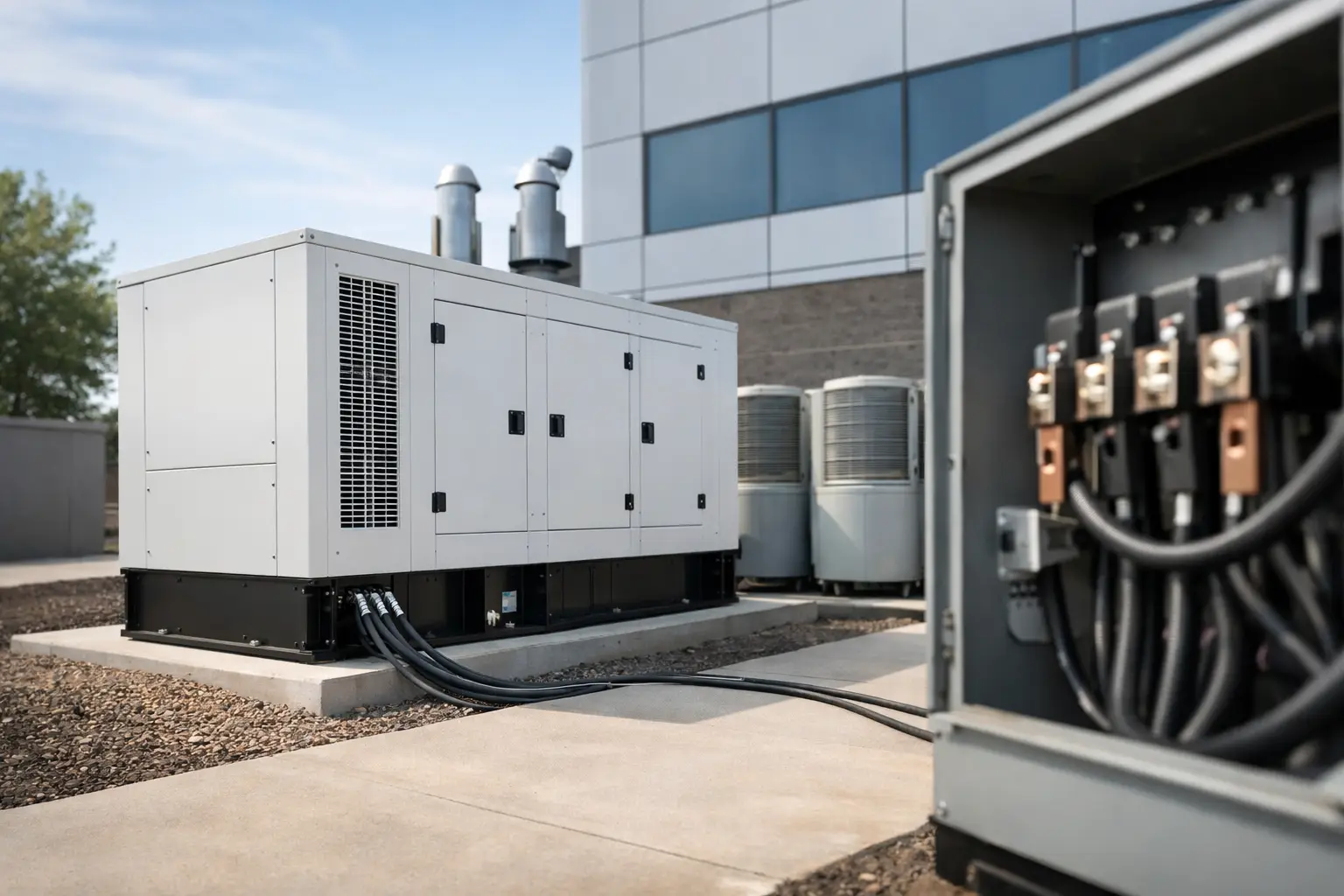
A generator does not protect your business by itself. The transfer switch is what safely shifts the building from utility power to generator power and back again. For commercial applications, transfer switch selection is a major part of the design, not an afterthought.
The switch has to match the electrical service and the intended load strategy. In some buildings, a single automatic transfer switch is enough. In others, multiple switches are used to separate critical loads from less essential loads or to support different panels and tenants.
Closed-transition switching, load shedding, and selective load management may also come into play. If your building has high inrush loads or limited generator capacity, staged load pickup can make the system more stable and more cost-effective. If uptime is especially sensitive, switching performance and distribution design deserve closer attention.
Fuel choice affects reliability as much as generator size
One of the most overlooked commercial backup generator requirements is fuel planning. The generator is only as dependable as its fuel supply under real outage conditions.
Natural gas is attractive because it avoids on-site refueling and supports long-duration operation in many areas. But it is not automatically the best answer for every property. Gas service capacity, pressure, utility constraints, and local approval requirements all matter. In some cases, service upgrades are needed before the generator can be supported.
Diesel often provides strong performance for high-demand commercial applications, but it brings fuel storage, environmental, and maintenance considerations. Tanks, spill containment rules, fuel quality management, and periodic polishing may all become part of ownership.
Propane can be a good fit where natural gas is unavailable, though runtime depends on tank size and refueling logistics. For businesses in remote areas or outage-prone regions, fuel delivery access during storms should be part of the planning conversation.
Sound, location, and access are not minor details
Commercial buyers often focus on kilowatts and switchgear first, but placement can decide whether a project moves smoothly or runs into delays. A generator needs proper clearance for combustion air, cooling airflow, exhaust discharge, and service access. It also needs to be located where noise, vibration, and emissions will not create avoidable issues with neighbors, tenants, staff, or customers.
If your property has limited exterior space, the installation may require more coordination than expected. Rooftop placement, pad construction, crane access, snow conditions, and proximity to doors, windows, and air intakes can all affect the design.
A good layout also considers maintenance from day one. If technicians cannot safely access the unit, routine service becomes harder, slower, and more expensive. That may not show up in the initial quote, but it shows up over the life of the system.
Testing and maintenance are ongoing requirements
A backup generator that sits unused for years is not automatically ready for the next outage. Commercial backup generator requirements do not end at startup. Regular exercise, inspection, preventive maintenance, and periodic testing are part of what makes the system dependable.
Batteries fail. Fuel degrades. Connections loosen. Control issues show up quietly until the day the utility fails. That is why long-term service should be treated as part of the installation decision, not a separate issue to solve later.
For many businesses, remote monitoring is worth considering. It helps catch alarms, exercise failures, battery problems, and maintenance needs before they turn into outage-time surprises. That matters even more if the property is unattended overnight or managed across multiple locations.
Why professional execution matters
Commercial generator projects are easy to underestimate. On the surface, it can look like a generator, a pad, and a switch. In reality, the job often involves electrical design, gas or fuel coordination, permitting, structural planning, startup commissioning, and long-term support.
That is where low-cost installation can become expensive. If a contractor guesses at sizing, skips load planning, mishandles permitting, or disappears after commissioning, the owner is left carrying the risk. The system may still start on a sunny test day, but that does not mean it is truly ready for a winter outage, a fuel issue, or a full building load event.
A professionally managed project reduces those risks. It aligns the generator with the building, the code requirements, the operating needs, and the service plan that keeps the system ready after installation.
Choosing the right system for your business
The right commercial standby system is rarely the biggest generator you can afford. It is the system that matches your actual continuity needs, your site conditions, and your risk tolerance. For some owners, that means protecting only the systems that prevent damage or major interruption. For others, it means maintaining near-normal operations through a prolonged outage.
If you are evaluating commercial backup generator requirements, the best place to start is with a clear conversation about what your business cannot afford to lose. From there, the design can follow the real priority: keeping your operation safe, stable, and ready when utility power is not.