When the power goes out at a business, the generator is no longer a nice backup feature. It becomes the system that protects revenue, equipment, inventory, security, and customer trust. That is why a business generator maintenance plan should never be treated as an afterthought. If your generator only gets attention when it fails to start, you are already taking on more risk than most operations can afford.
For many business owners, the real problem is not knowing maintenance matters. It is assuming all service plans are basically the same. They are not. A real maintenance plan is built to reduce failure risk, catch wear before it turns into downtime, and make sure the generator will perform under load when the utility power drops without warning.
What a business generator maintenance plan is really for
A maintenance plan is not just a checklist for oil changes. It is a structured service program that keeps the entire standby power system ready to operate as designed. That includes the generator itself, but also the transfer switch, battery, fuel system, controls, connections, and overall operating condition.
For a business, readiness is the point. A generator can look fine sitting outside for months and still fail at the exact moment you need it. Batteries weaken. Fuel quality changes. Belts age. Sensors drift. Connections loosen. Software settings can be off. None of those issues are obvious from a distance, and many do not show up until the unit is asked to carry the building.
That is why preventive service is worth more than emergency repair. Emergency service deals with a problem after you already have disruption. Preventive maintenance is about avoiding that disruption in the first place.
Why businesses need more than a basic annual visit
Some properties can get by with a lighter service schedule than others, but most commercial applications need more than a once-a-year inspection. The right service frequency depends on how critical the load is, how often the generator exercises, the age of the equipment, site conditions, and whether the system has already shown signs of trouble.
A retail location, small office, restaurant, warehouse, medical practice, or mixed-use property all use backup power differently. A site protecting refrigeration or server equipment has a different risk profile than one covering lights and limited HVAC. The more costly the downtime, the less sense it makes to rely on minimal service.
There is also a practical issue many owners overlook. A generator system is part mechanical, part electrical, and part controls-based. Problems do not always come from major component failure. Sometimes they start with poor battery health, deferred fluid service, a charger issue, or a transfer switch problem that was never tested properly. Those are exactly the issues a strong maintenance plan is designed to catch.
What should be included in a business generator maintenance plan
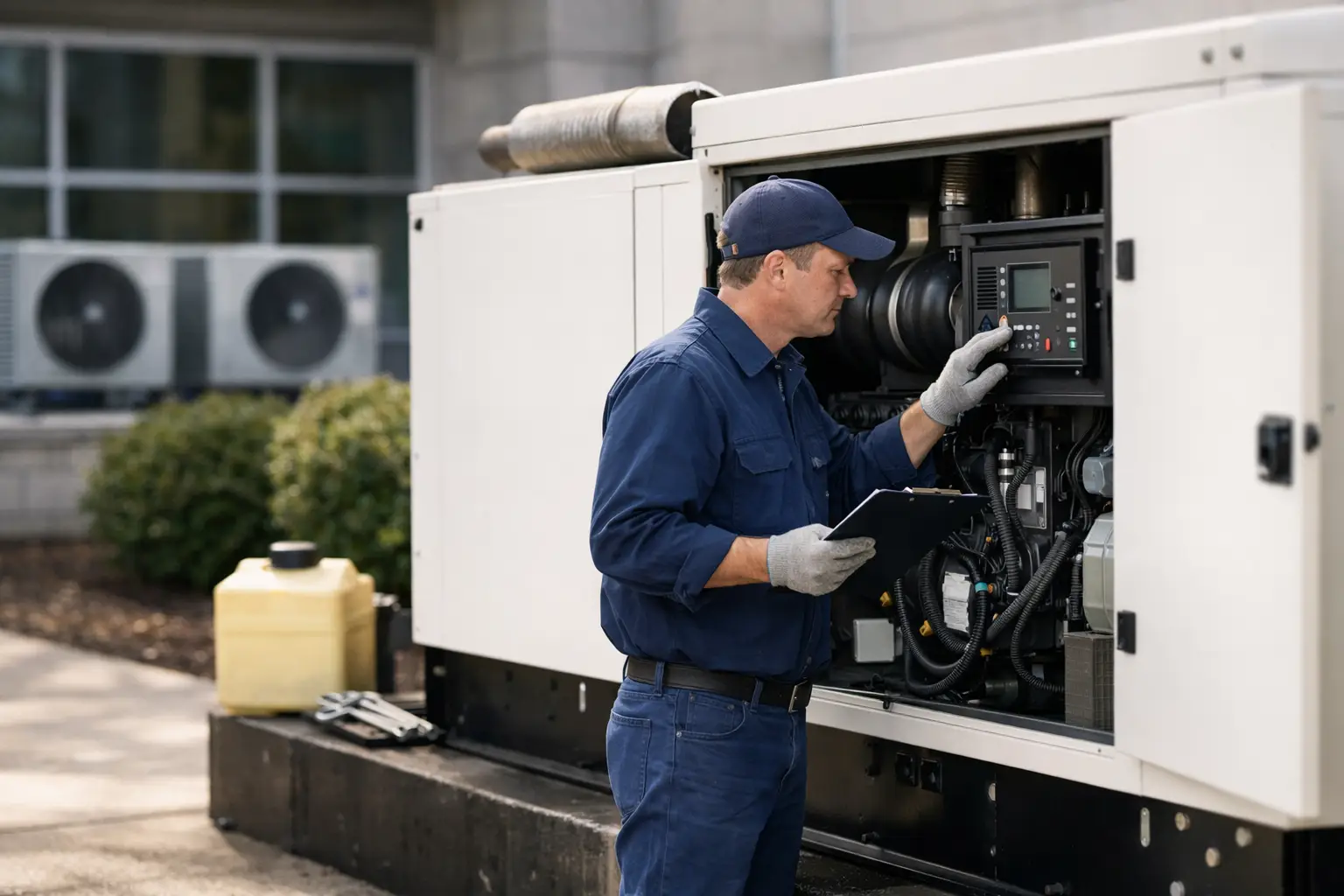
A good plan starts with scheduled inspections and preventive service based on manufacturer requirements and real operating conditions. At minimum, that should include fluid and filter checks, battery testing, inspection of hoses and belts, review of fault history, transfer switch testing, and confirmation that the unit starts, runs, and transfers correctly.
Load-related testing matters too. A generator that starts is not necessarily a generator that will support your building properly. In many cases, exercising the system and verifying performance under realistic conditions tells you more than a visual inspection ever will.
The plan should also address fuel quality where applicable, cooling system condition, electrical connections, and software or controller settings. For some sites, remote monitoring is just as important as on-site service because it helps identify alarms, missed exercise cycles, or abnormal behavior before a power outage exposes the problem.
Documentation is another part of the job. Business owners should know what was inspected, what was serviced, what issues were found, and what needs attention next. A vague invoice that says the unit was “checked” is not enough when continuity is on the line.
The difference between low-cost maintenance and reliable maintenance
This is where many businesses get burned. A low-price service offering often looks fine on paper because it includes a scheduled visit. But if that visit is rushed, incomplete, or performed by someone without the right training, the plan may create false confidence instead of real protection.
Reliable maintenance is not just about showing up. It is about knowing the equipment, following proper procedures, understanding code and manufacturer requirements, and taking ownership of the system over time. If a contractor only appears for the easy work and disappears when there is a real problem, you do not have a maintenance partner. You have a weak point in your backup power strategy.
That does not mean the most expensive plan is automatically the best one. It means business owners should look at scope, technician qualifications, response expectations, testing procedures, and service accountability. Price matters, but it should be weighed against the cost of failed backup power during a real outage.
How to choose the right plan for your operation
The best business generator maintenance plan matches the consequences of failure. If losing power means brief inconvenience, your service needs may be straightforward. If losing power means lost sales, spoiled product, tenant disruption, data issues, or safety concerns, your plan should be more proactive.
Start by asking what the generator is expected to support and how long it may need to run. Then look at the age and brand of the equipment, service history, fuel type, and whether there is remote monitoring or a transfer switch with known issues. These details shape the right maintenance schedule.
It also helps to ask practical questions before signing any service agreement. Who performs the work? Are they licensed and factory-trained? Is transfer testing included? Are batteries tested or just visually inspected? Will you receive service records and recommendations? Is emergency support available if the generator alarms or fails during an outage?
The answers tell you a lot. A serious provider will be clear about what is included, what is not, and what they are responsible for. That clarity protects you just as much as the maintenance itself.
Common gaps that lead to generator failure
Most generator failures are not random. They usually come from neglected basics. Battery issues are one of the biggest causes of no-start events, especially when the battery charger has a problem that went unnoticed. Deferred oil and filter service can shorten engine life. Fuel contamination can affect performance. Cooling system issues can force shutdown during longer run times.
Transfer switch problems are another major risk. Even if the generator starts, power may not move to the building correctly if the transfer equipment is not operating as it should. That is why maintaining the full standby power system matters more than focusing only on the generator enclosure outside.
Environmental conditions also matter. Dirt, moisture, rodents, vibration, and temperature swings can all affect reliability over time. A plan that works for a clean, lightly used site may not be enough for a more exposed or demanding location.
Why long-term service support matters
Generator ownership is not a one-time transaction. It is an ongoing responsibility. The businesses that get the best results are usually the ones that treat maintenance as part of the original investment, not as an optional add-on to revisit later.
That is also why service continuity matters. When the same qualified provider understands your site, your load, your equipment history, and your priorities, problems get addressed faster and with less guesswork. You are not starting from scratch during every visit, and you are not scrambling to find help when the weather turns bad.
For many owners, peace of mind comes from knowing there is a clear plan, a service record, and a team that stands behind the system after installation. That is the standard GenTek Power believes backup power service should meet.
A maintenance plan protects more than the generator
The real value of a maintenance plan is bigger than the machine itself. It protects business continuity. It protects staff and customers from the disruption that follows a preventable failure. It protects the money you already invested in standby power and gives that investment a better chance of performing when conditions are at their worst.
If your generator is there to keep your business open, your systems online, or your building secure, maintenance is not extra. It is part of the protection. The right plan makes sure your backup power is not just installed, but ready when the lights go out.